
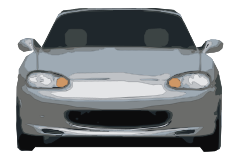
Suspension rubber-bushed joints — final tightening condition (2001–2003)
Tighten suspension joints that use rubber bushings only with the vehicle lowered and unloaded: fuel tank full, engine coolant and oil at specified levels, and spare tire, jack and tools in their designated positions.Tighten suspension joints that use rubber bushings only with the vehicle lowered and unloaded: fuel tank full, engine coolant and oil at specified levels, and spare tire, jack and tools in their designated positions.
This common precaution applies to front and rear suspension joints that use rubber bushings. Complete final tightening in the lowered vehicle condition Mazda defines here, using the torque and replacement requirements for the particular fastener. This record supplies the vehicle condition only; it does not assign one torque to all suspension joints or authorize tightening while working beneath an unsupported vehicle.
- NB 2003 (BP-Z3)
- NB 2001–2002 (BP-Z3) — 2001–2002 applicability follows the owner-approved early-NB2 carry-over policy, with hardware, test setup and connector perspective compared against publication 1719-1U-01G. Its existing owner-accepted 2002 source coverage is unchanged; 2001 is carry-over, not an independently verified year.
- Verified in: 2003 Mazda MX-5 Miata Workshop Manual (electronic manual capture); Mazda MX-5 Workshop Manual, publication 1719-1U-01G (2002 base edition)
Sources (4)
View 4 source citations
- Mazda MX-5 Workshop Manual, publication 1719-1U-01G (2002 base edition)Tier 1
Page 02–10–1 (PDF p. 412) · Printed value & notes
Part no. 1719-1U-01GPage 02–10–1 (PDF p. 412)Printed: “1. Tighten any part of the suspension that uses rubber bushings only after the vehicle has been lowered and unloaded. Note • Unloaded... Fuel tank is full. Engine coolant and engine oil are at specified levels. Spare tire, jack, and tools are in designated position.”Visually checked against the original factory page; printed units and component/test context retained. Source edition/market limitations remain as documented; no additional verified years assigned. - 2003 Mazda MX-5 Miata Workshop Manual (electronic manual capture)Tier 1
Page Precaution (Suspension) (PDF p. 911) · Printed value & notes
Page Precaution (Suspension) (PDF p. 911)Printed: “Tighten any part of the suspension that uses rubber bushings only after the vehicle has been lowered and unloaded. NOTE: Unloaded... Fuel tank is full. Engine coolant and engine oil are at specified levels. Spare tire, jack, and tools are in designated position.” - 2003 Mazda MX-5 Miata Workshop Manual (electronic manual capture)Tier 1
Page Precaution (Driveline/Axle) (PDF p. 983) · Printed value & notes
Page Precaution (Driveline/Axle) (PDF p. 983)Printed: “Tighten any part of the suspension that uses rubber bushings only after vehicle has been lowered and unloaded. NOTE: Unloaded... Fuel tank is full. Engine coolant and engine oil are at specified level. Spare tire, jack, and tools are in designated position.” - 2003 Mazda MX-5 Miata Workshop Manual (electronic manual capture)Tier 1
Page Driveline/Axle service (PDF p.983) · Printed value & notes
Page Driveline/Axle service (PDF p.983)Printed: “Tighten any part of the suspension that uses rubber bushings only after vehicle has been lowered and unloaded. Unloaded... Fuel tank is full. Engine coolant and engine oil are at specified level. Spare tire, jack and tools are in designated position.”Original axle precaution corroborates existing final-tightening condition for suspension rubber-bushed joints. No universal torque or unsupported under-vehicle access inferred.
Related service specs
- Front wheel bearing axial play — maximum (1990–1993)
- Front upper ball-joint dust boot seating clearance (1992–1993)
- Maximum road-wheel steering angle (1990–1993)
- Front factory coil spring dimensions — 5MT (1992–1993)
- Front factory coil spring dimensions — 4AT (1992–1993)
- Alignment pre-inspection — maximum left/right ride-height difference (2001–2003)
- Front total toe-in — approximate change per equal tie-rod turn (2001–2003)
- Front alignment adjustment order (2001–2003)